


KEY INSIGHTS
- Employee trust usually breaks down before it shows up in attrition or performance data.
- Employees lose trust in leaders less from one major mistake and more from repeated inconsistencies.
- There is a visible sequence for rebuilding trust within your team.
The feeling that you’re losing your team (that there’s a side chat you’re not in on … and that it’s not good) tends to hit well before the hard numbers show up in retention or performance. By the time employees start leaving, you’ve usually already lost them.
Great Place To Work® has surveyed more than 100 million employees around the world since 1992, and those decades of data consistently point to one conclusion: the defining quality of a great workplace is trust.
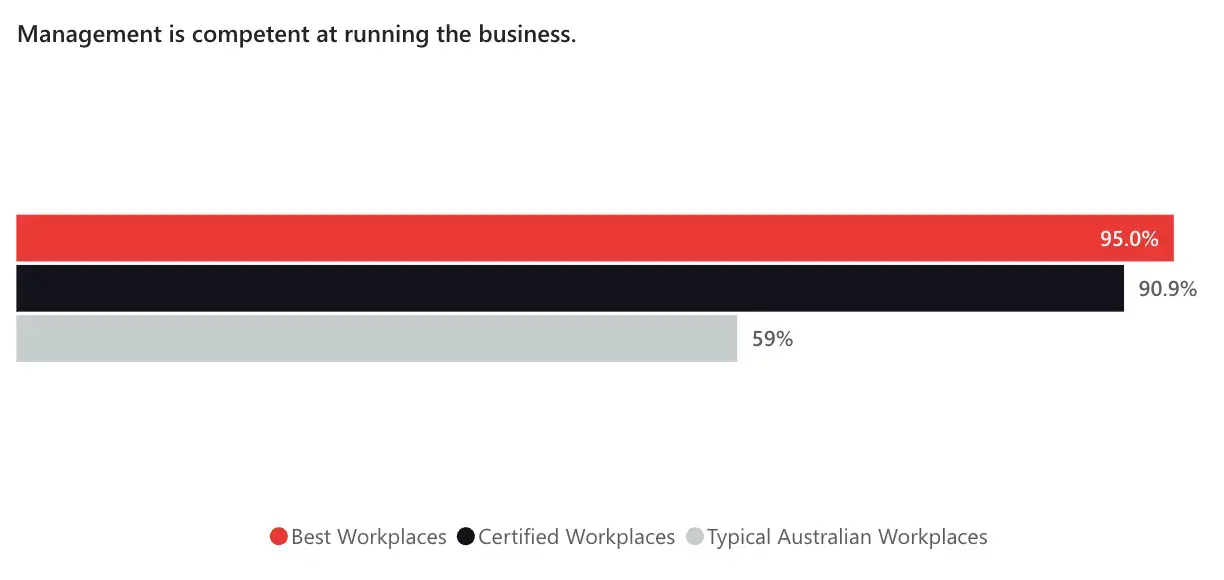
In Australia, only 59% of employees at typical workplaces believe that management is competent at running the business they work for, and only 54% say that they think their leaders are ethical and honest in their business practices. When employees lose trust in management, when they stop seeing their leaders as credible and lose faith in your ability to guide them, the workplace feels it long before the exit interviews begin to confirm it.
What losing trust in leadership looks like
The signs of your team losing faith in you usually shows up first what people stop saying, what they stop volunteering, and how carefully they begin to manage risk.
Classic red flags that you’ve lost employee trust are:
-
You challengers go silent. People stop raising concerns in meetings, even when it is obvious something is not working. People save their honest views for private chats instead.
-
Feedback on projects also gets safer and vaguer, with fewer direct opinions.
-
New ideas start to dry up and employees seem less emotionally invested in the work.
-
More sloppy mistakes and problems are raised later than they should be, once they are harder to fix or impossible to ignore.
-
Responses get slower and managers find themselves having to chase updates instead of people sharing progress on their own.
-
Collaboration becomes more transactional, with people doing what is required but little more.
-
Conversations feel more guarded or overly polished, as if everyone is choosing their words too carefully. It’s a major red flag when you can tell that most of your team is communicating to you through an AI filter.
-
Conversations center exclusively on job-related matters and start to completely lack a personal element.
-
Survey results start to fill up with neutral responses where you used to see champions, or even detractors.
-
Your team becomes more image-conscious around you, people focus more on how they are perceived by you than on solving the problem itself. Updates become more performative, and decisions more shaped by self-protection.
-
People start opting out of team rituals, social moments, or informal group time. There’s a growing distance from the culture around them and a weaker sense of connection, belonging, or trust.
-
People stop talking about the future. Conversations about long-term goals, shared success, or what comes next begin to fade, replaced by a narrower focus on getting through what is in front of them.
These changes can look minor in isolation but together, they often signal that people are no longer fully convinced it is safe, useful, or worthwhile to speak candidly. By the time trust loss becomes visible in resignations or open frustration, it has often been building for months.
How leaders lose the trust of their people
Leaders rarely lose their credibility through one dramatic mistake. More often it’s through repeated moments that make employees question whether leadership is credible, fair, or worth believing.
It happens when leaders ask for feedback and never report back on what changed. It happens when they promise action after survey results, then let the issue disappear without explanation. It happens when difficult decisions are announced without context, when bad news reaches people through rumour before leadership addresses it, and when employees are expected to absorb uncertainty on their own.
Trust also weakens when leaders become inconsistent. Priorities shift without explanation, standards are applied unevenly. Recognition feels selective, some voices carry weight while others are ignored.
Over time, employees stop reading these moments as isolated lapses and start seeing them as evidence that leadership cannot be relied on. Managers hold back problems they used to surface early because experience has taught them that speaking up won’t lead to action.
How to rebuild trust once it starts slipping
When trust starts to slip, many leaders default to visibility. They schedule a town hall, strike a more upbeat tone, and try to reset the mood. That instinct is understandable, but credibility rarely returns because of a single all-hands.
What tends to work is a sequence: acknowledge the problem, understand the experience behind it, respond to the real issue, and keep showing that change is happening.
Acknowledge the issue directly
Trust does not recover when leaders soften the message or talk around the problem. People need to hear a clear acknowledgment that something has shifted and that leadership is not pretending otherwise.
Take responsibility where it belongs
If trust has been damaged by poor communication, inconsistency, unfair decisions, or a lack of follow-through, leaders need to say so plainly. Employees are far more likely to re-engage when leadership shows accountability instead of defensiveness.
Understand what people actually experienced
Surveys are a great way to pick up where trust is weakening, but they don’t always explain why. To understand the gap, leaders need to look at comments, patterns across groups, and the conversations happening around the data.
Act on the issue employees raised
Trust rebuilds faster when the response matches the concern. If the issue is fairness, workload, communication, or inconsistent management, the action needs to address that problem directly rather than offering a generic culture initiative.
Show what will change in practice
Employees need more than reassurance. They need to know what is changing, who is responsible, and what they should expect next. Trust starts to return when action feels concrete, visible, and hard to mistake for symbolism.
Keep proving it over time
Trust is only rebuilt through consistency and repeated evidence. Leaders need to report back, share progress, and show that feedback is still shaping decisions. A single update may create interest; consistency is what restores credibility.
How to measure trust (and why you should)
In the Great Place To Work Trust Index model, credibility is assessed across a whole spectrum of confidential statements, from looking at whether leaders communicate honestly to whether their actions match their words and if they’re making leadership decisions visible and explicit.
Our global research has found that trust in leadership is the top driver of things like retention and discretionary effort and that employees with high trust are 3.9 times more likely to say they want to work at their organisation for a long time, and 1.51 times more likely to give extra effort.
To build a fuller picture, the best workplaces tend to look at trust alongside intent to stay, productivity, purpose, and well-being. Because the real warning sign is not only when people leave, but when they stop believing, contributing, and connecting long before they go.
ALSO READ: The 5 Top Reasons Employees Give Up And Check Out

Frequently Asked Questions About Employee Trust
What are the early signs that employees are losing trust in leadership?
The earliest signs are behavioural changes that appear before formal disengagement. Look out for things like reduced participation in meetings, safer and vaguer responses to feedback, and /or a drop in discretionary effort. Employees stop raising problems they’d previously flag and become more transactional in how they collaborate. Trust erosion tends to appear in what you stop hearing before it shows up in survey scores or turnover data.
Why do employees lose trust in their managers?
Research consistently points to a gap between stated intent and lived experience. Employees lose trust when feedback is gathered but no visible action follows, when difficult news travels informally before leaders communicate it directly, and when commitments made in one setting are quietly abandoned in practice. The issue is rarely a single incident. It’s the accumulated pattern of small misalignments between what leaders say and what employees observe.
How can HR leaders rebuild trust after a culture dip?
Rebuilding trust requires a sequence rather than a single gesture. Acknowledge the issue directly and specifically, create conditions for honest feedback to surface, act visibly on what employees raised, and keep communicating about what changed and why. The repair that lasts is almost always traceable to specific concerns employees identified. Generic culture initiatives launched after a bad survey cycle rarely move the needle, because they don’t close the feedback loop in a way employees can recognise.
How does Great Place To Work measure employee trust?
The Great Place To Work Trust Index™ survey measures the structures behind employee sentiment, specifically credibility, respect, fairness, pride, and camaraderie. Employees respond to 60 statements on a five-point scale and answer two open-ended questions, providing confidential feedback about their organisation’s culture. The Trust Index score represents the percentage of employees who consider their company a great workplace, and is used to benchmark organisations against peers across more than 10,000 companies globally.

