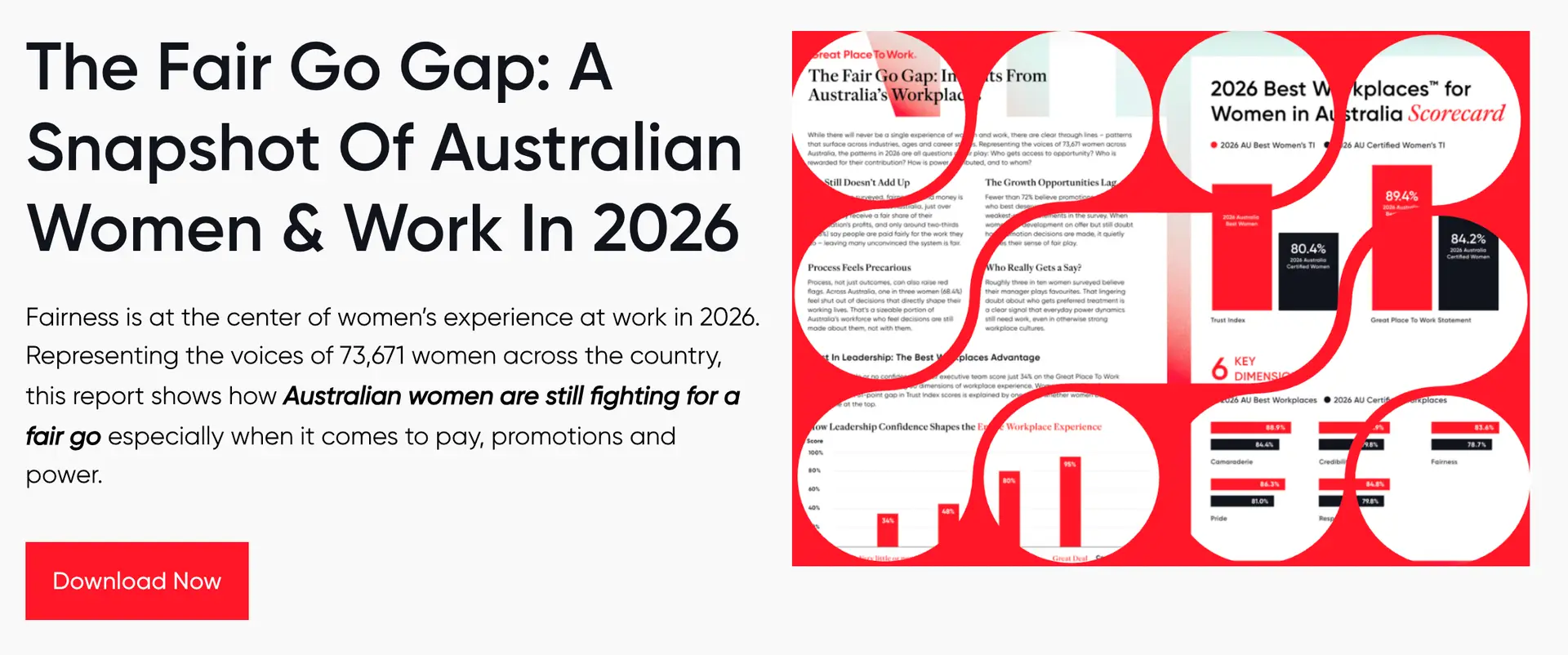


Parallel to this year’s International Women’s Day theme, Balance the Scales, a new report shows that a lot of Australian women are still fighting for a fair go especially when it comes to pay, promotions and power.
The concept of fairness, and who has access to it, is at the center of women’s experience at work in 2026. Representing the voices of 73,671 women across the country, our latest data shows tens of thousands of Australian women questioning whether even the most basic rules of engagement in the workplace are fair.
The Fair Go Gap report data shows that for women, the scales are tilting at three critical points: pay, opportunity and power. Just over 54% of women surveyed feel they receive a fair share of their organisation’s profits, and only around two‑thirds believe people are paid fairly for the work they do. Fewer than 72% of women believe promotions go to those who best deserve them, one of the weakest‑rated statements in the entire survey of 60 points.
Process is also where many organisations lose the plot. One in three women surveyed said they feel shut out of decisions that directly shape their working lives, and roughly three in ten believe their manager plays favourites. That is what imbalance feels like on the ground, a daily calculation about whether it’s worth speaking up, stretching for the next role, or letting things build up until you move on.
Obviously these points all stand to have a massive impact on staff retention rates. Recent Australian analyses suggest that every time an employee leaves, it typically costs businesses at least 30–50% of that person’s annual salary, and for specialist or senior roles, the total bill can blow out to 150–200% once you add recruitment, onboarding and lost productivity, according to findings from National Training, Scale Suite and Foremind’s 2026 research on Australian organisations.
ALSO READ: WHICH 50 COMPANIES MADE THE AUSTRALIAN BEST WORKPLACES FOR WOMEN LIST
One of the most sobering finds in The Fair Go Gap report, created from the data gathered for Australia’s Best Workplaces™ for Women 2026 awards was generational. For women under 35, roughly one in three say politicking and backstabbing are still part of how things get done and that they believe that their managers play favourites, compared with one in four women aged 35–44. These are the years when careers should be built on stretch, feedback and opportunity, but the rules feel least fair just as futures are being formed. If we fail this cohort, we are not just delaying progress; we’re hard‑coding distrust into the next generation of leaders.
A true IWD test for leaders this year might be to ask whether women, especially under 35, would say your organisation is a place where the rules are fair, the process is transparent and leadership can be trusted. For Australian women at work, balancing the scales starts there, in whether women believe the game they’re playing with you is genuinely fair.